
Blog · World coins · September 14, 2026
The Spanish dollar in the drawer: what an 8 reales is, and why it turns up in Ontario
Pieces of eight were the first dollars in North America and they still surface in Eastern Ontario estates. How to recognise one, weigh one, and tell a real one from a casting.
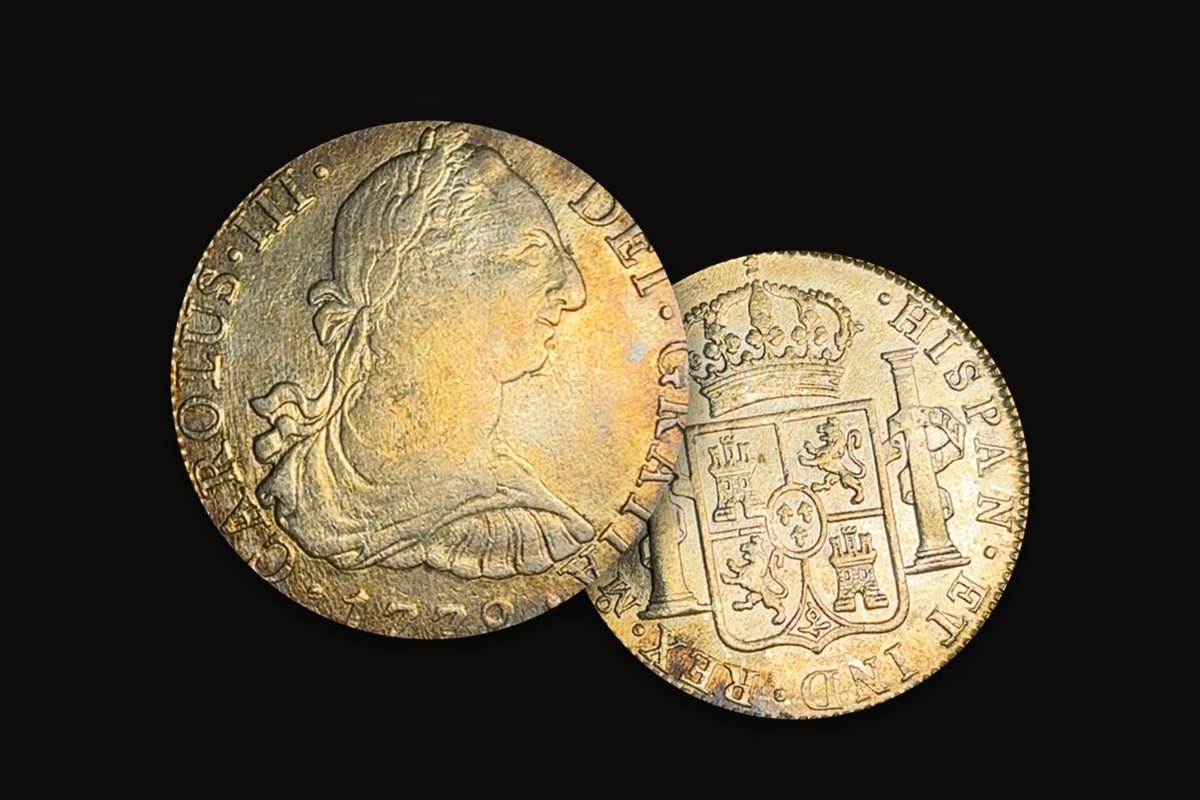
The coin in the photo is a Mexico City 8 reales from 1779, struck under Carlos III of Spain. It came to us this week, and it is the kind of coin that makes a house call worth doing: big, heavy, three hundred years of history, and routinely mistaken for a token or a “foreign coin” by people sorting an estate.
The original dollar
Before Canada or the United States issued a dollar of their own, the Spanish 8 reales was the dollar. Struck in silver at mints across the Spanish empire, above all Mexico City, it was the most trusted coin in the world for two centuries. It’s the “piece of eight” of pirate stories, and it’s the coin the United States copied when it designed its first silver dollar. It stayed legal tender in the US until 1857. In British North America it circulated freely well into the 1800s, and the old “Halifax currency” accounts were kept in Spanish dollars. Thousands of them passed through Kingston as an army town and a lake port. That is why they still turn up in drawers here.
How to recognise one
The portrait type, like ours, has the king’s bust on one side with his name in Latin, CAROLUS III DEI GRATIA, and the date. The other side carries the crowned Spanish arms between two pillars, with HISPAN ET IND REX, the denomination 8R, a mint mark and the assayers’ initials. Mexico City’s mark is a small M with a circle above it. Earlier coins, before 1772, have the pillars-and-globes design instead of a portrait; those are worth more.
A genuine 8 reales weighs about 27 grams and is just under 40 millimetres across. Ours weighs in exactly where it should. Weight is the first thing we check, because the second thing you need to know about these coins is that they have been copied for as long as they have existed.
Real or cast?
Modern copies are everywhere, mostly cast from a real coin, sold as souvenirs, and sometimes passed on as genuine. The tells are usually simple. A casting is light, often by two or three grams. The surface has a soft, soapy look with tiny pits, where a struck coin has crisp detail and flow lines. The edge is the giveaway: a genuine portrait 8 reales has a distinctive edge design of alternating circles and rectangles, and copies rarely get it right. And a real one rings; a casting thuds.
Chop marks, small punched symbols added by Chinese merchants who tested the coins in trade, are not a flaw. They’re proof of a working life, and some collectors seek them out.
What one is worth
It depends on the date, the mint, the condition and whether it has been cleaned. Common dates in worn condition sell for a modest premium over silver. Better dates, better grades and original surfaces climb from there, and the early pillar types and the scarce mints can be serious money. Ours has the kind of colour that only comes from being left alone for a very long time, and it’s listed in the store now.
If you’ve found one, don’t clean it, don’t test the edge with a knife, and don’t take it to someone who’s going to weigh it and pay silver. Send us a photo of both sides and the edge. We’ll tell you what it is.
Coin & Co Numismatics, Kingston, Ontario. We buy, sell and value coins, and we photograph everything ourselves, unedited.